


An office chair without wheels makes sense when the person does not need to roll toward a desk, storage or nearby equipment. It can suit a visitor seat or a meeting position that stays in one place. The seat still needs to fit the person and the work surface.
No wheels does not necessarily mean no swivel, no height adjustment or no sliding. Decide which movement you want to remove—and which movement the task still needs—before choosing a fixed base.
When staying in one place serves the task
A visitor seat away from a working desk: A guest waiting in reception may only need to sit, speak and stand again. A chair on fixed feet can serve that position without rolling travel, provided the approach and exit remain easy. That does not mean the receptionist should use the same chair: their keyboard, visitors and storage may demand different movement.
A meeting position with one main facing direction: For a discussion around one table, a non-rolling chair can work when people can reach their materials without shifting the base. If the meeting alternates between a side screen and the group, a seat that swivels above glides may add useful turning without casters.
An assigned note-taking or training position: Fixed seating can suit individual notes at a table or on a properly fitted writing tablet when the room does not need continual rearrangement. Check the actual writing position and entry opening, especially with a side-mounted tablet.
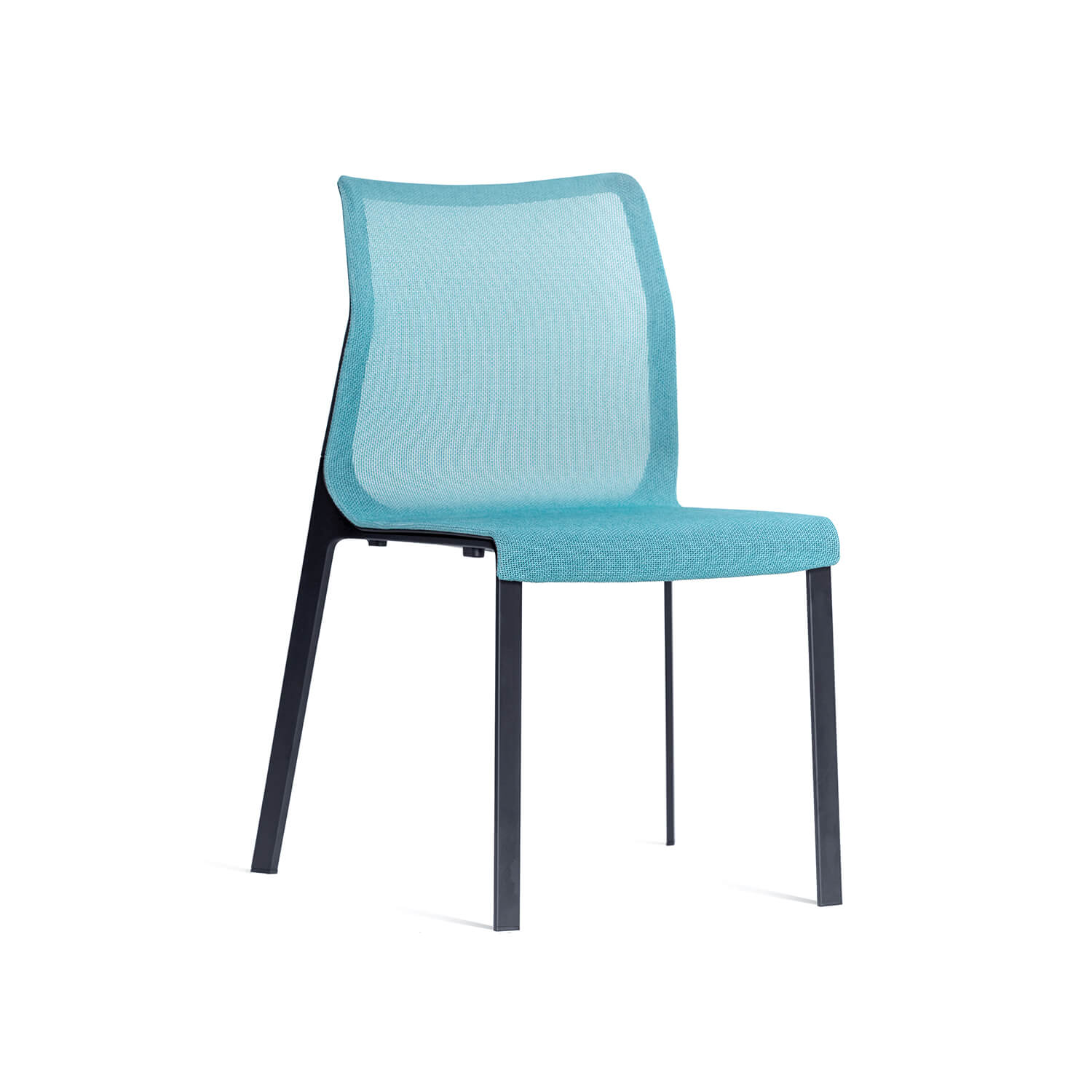
Turquoise Pegus chair with an armless mesh seat and four fixed legs.
CCOHS chair-selection guidance notes that casters can hinder work needing a stationary position. It also makes the person, workstation and task central to the choice. Staying put is useful only when it supports that activity.
When missing rolling movement gets in the way
Desk reach: At a computer desk, people often move closer to the keyboard and back again to stand. If a no-wheel chair needs repeated lifting or awkward shuffling to reach the working position, compare a suitable rolling chair. Do not replace the missing movement by leaning farther across the desk.
Swivel is not rolling: Seat rotation and floor travel solve different problems. A swivel on glides can help you face a nearby person or display, but it does not bring distant storage within reach. Put frequently used materials nearer or change the layout instead of treating rotation as a substitute for repositioning.
A fixed foot or glide can still slide on a floor; it is not an anchor. Likewise, a broad-looking base is not a tested tipping rating. If a chair rocks or moves unexpectedly, stop using it until its feet and floor contact are checked. Emory University chair-safety guidance recommends removing damaged chairs from use.
Frequent changes from rows to small groups create another need: moving empty chairs. A design that suits the seated activity may be cumbersome for the staff resetting the room. Compare both jobs before choosing.
Keep the seat and table working together
A fixed-height chair gives you fewer ways to correct a mismatch with a fixed-height desk. No-wheel models with suitable adjustments are different from simple visitor frames. Compare the actual controls and dimensions, not only the base.
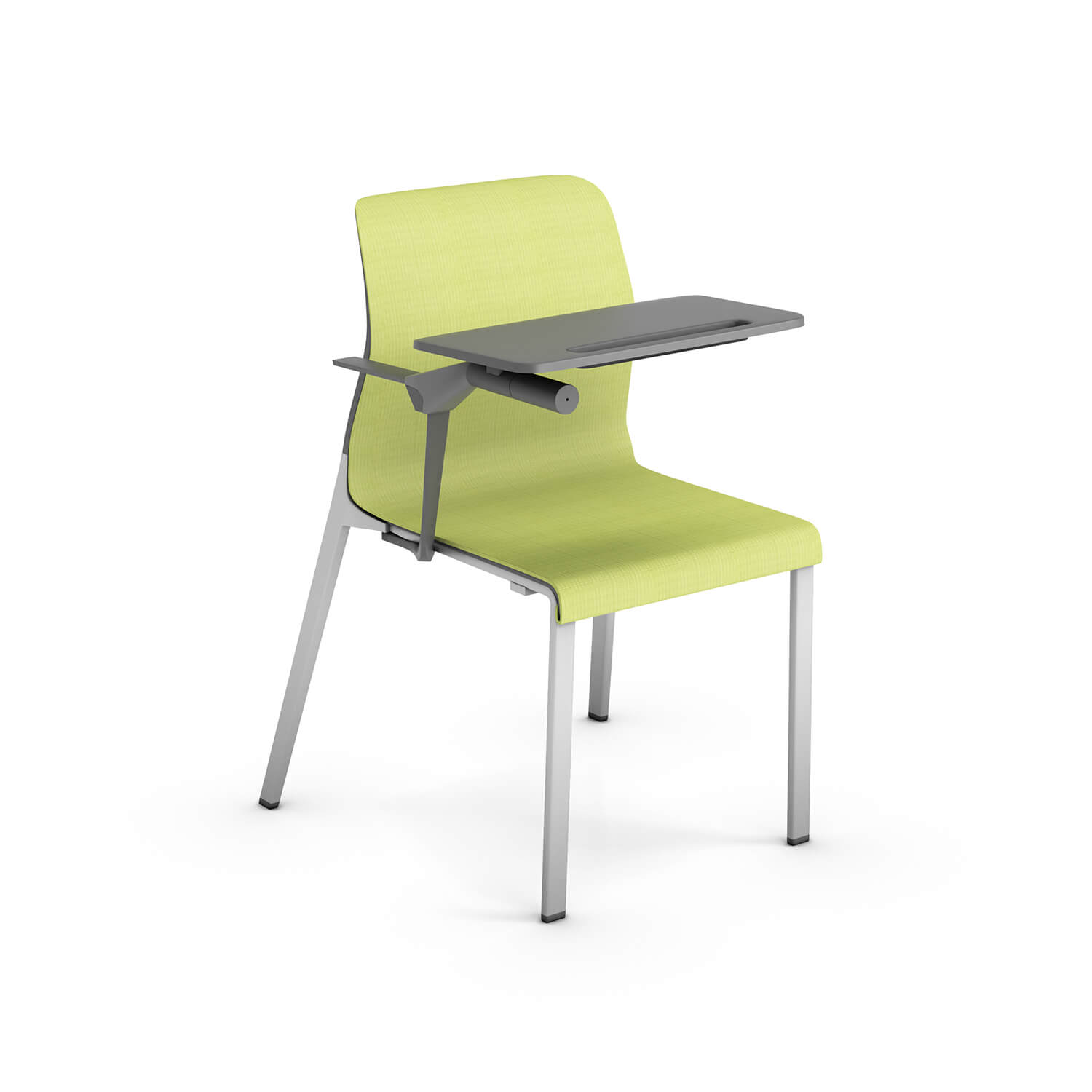
Lime-green Pegus chair with fixed legs and a writing tablet.
Sit back with your feet supported and space behind your knees. A deeper seat is not corrected simply by adding a footrest.
Reach the keyboard or writing area without the arms or tablet holding you away from it. Check the table's lowest rail as well as its top.
Get on and off in the normal way, with adjacent seats in place. Include different users in a shared room.
CCOHS adjustment guidance explains the relationship between the seat, work surface and floor. If the fixed chair cannot give the user a supported working position, choose another seat or change the work surface.
After identifying suitable candidates, let staff try them during the actual activity, as CCOHS purchasing guidance recommends. Record concrete differences such as arms hitting the rail or needing to move the whole chair to face the display.
Office chair dimensions should be checked at the usable seat and opening, not inferred from the complete chair's outside size.
Consider the floor and the empty-chair move
A no-wheel chair still moves when it is pulled out or the room is reset. Match the feet or glides to the chair and floor instructions, keep debris away from the contact area, and inspect pads for missing parts or wear. Check rug edges along the route, not only the parked position.
A University of Virginia report from 2019 described carpet-edge damage where chairs stood partly on carpet and partly on hardwood. It also recorded good results with felt glides in other Rotunda rooms, supported by repeated inspection and replacement. That is a specific facility example, not a guarantee that felt suits every floor.
SpaceUnited's Pegus fixed-leg training chair uses a four-leg frame with nylon foot pads. Its armless and writing-tablet arrangements change access to the seat and work area. Compare the configuration you intend to use at the actual table.
For a room with frequent resets, compare the mesh rolling training chair as an alternative. Follow each design's intended handling and storage method. A trolley for stored fixed chairs serves a different purpose from wheels under an occupied chair; do not assume that every fixed chair stacks or can be moved in the same way.
Questions about using chairs without wheels
Can I replace my chair's wheels with glides?
Only if the chair maker specifies compatible glides for that exact model. A matching-looking stem does not establish suitability, and a different foot height can change the seat position. Use the specified parts and installation instructions.
Can people of different heights share a fixed-height chair?
Only when the seat and table fit each person. A footrest may help unsupported feet, but it does not shorten a deep seat or make more room beneath the table. Compare adjustable seating or different sizes if a supported position is not possible.
Can a chair without wheels work at a computer desk all day?
Yes, if the seat fits the user and desk and the work does not require frequent rolling. Try it at the actual keyboard during a normal work session. If reaching means repeatedly lifting the chair or leaning forward, use a suitable rolling chair or change the layout.
What if the chair sits across carpet and hard flooring?
Keep its usual sitting and pull-out path on one suitable surface if possible. Chair feet crossing that boundary can wear a carpet edge, as the University of Virginia facility example above shows. Inspect the transition and use feet specified for the chair and floor before placing more chairs there.
Can fixed-leg chairs be stacked or moved on a trolley?
Only when the specific model and configuration permit that method. A four-leg frame alone does not establish stackability, and a writing tablet can change the space needed for storage. Follow the stated handling instructions and assess room-reset work separately from seated comfort.
What should I do if a fixed chair rocks or slips when someone sits down?
Stop using that chair until the cause is checked. Look for a missing or worn foot, debris under a glide, or uneven floor contact. Use compatible replacement parts or another chair if the setup cannot be made sound.
Remove rolling only when the work does not need it
Choose fixed feet when the seated task works in one position and entry, exit and room setup remain practical. If users keep shifting the whole chair to work, compare a swivel, rolling chair or better layout. Wheel choice does not replace seat and table fit.
Try a fixed-foot candidate and a rolling alternative during the room's normal task before choosing the chair configuration.


Office Chair Casters for Hard Floors: Fit, Materials & Floor Protection
A wheel that looks softer is not enough to approve a caster change. Facilities teams need a documented match among the floor, the chair base, the caster interface, and the way the chair must roll.When choosing office chair casters for hardwood floors, start with the flooring product and finish, then
/ Read More
Why Does an Office Chair Keep Sinking? Safe Checks & Repair Decisions
A chair that drops after you set the height needs attention, but the movement alone does not prove which internal part is at fault. The safest response is to stop guessing and separate what you can observe from what a manufacturer or qualified repair provider must assess.If your office chair keeps s
/ Read More Office Chair vs Gaming Chair: Adjustments, Fit and Long-Session Use
One chair may need to handle focused work, video calls, mouse-and-keyboard play, controller sessions, and relaxed viewing. A shelf label cannot tell you whether its seat, controls, or support will fit those tasks.For an office chair vs gaming chair decision, start with the exact models.
/ Read More
Office Chair Dimensions: Seat Width, Depth, Height & Desk Fit
Before ordering an office chair, check two things separately: whether the seat and arms fit the user, and whether the complete chair can reach the desk. Office chair dimensions such as overall width and total height cannot answer both questions.Start with named measurement points, then record the ad
/ Read More
What is the best office chair for sitting all day?
The best office chair for sitting all day gives great support and comfort. It also helps keep your body healthy. SpaceUnited is a top company for ergonomic office furniture. They make smart chairs that help people feel better at work. Studies show an ergonomic office chair can help you work better.
/ Read More
How to properly adjust an office chair for optimal comfort?
Many people sit at desks and ask why their backs hurt or shoulders feel tight. An office chair that fits well can help a lot. Changing things like lumbar support, seat depth, and armrests lowers strain. It keeps your body relaxed and helps you sit in a healthy way. SpaceUnited makes ergonomic office
/ Read More