


Commercial office desks are workstations for offices, not homes. They stand up to long workdays, heavy use, and strict safety rules. These desks differ from home furniture in materials, construction, and design intent.
Modern offices depend on them for productivity, ergonomics, and a professional look. A sturdy desk supports focus. An ergonomic layout protects health. A clean design changes how clients and staff see the business.
Business owners, office managers, and procurement specialists all face the same problem. They must choose desks that meet real needs without wasting money. Good choices start with clear definitions and practical standards. Smart buyers ask direct questions before they spend.
What Are Commercial Office Desks?
Commercial office desks are professional workstations made with high-density materials for daily business use. They differ from residential desks in three key ways. First, they handle heavier use. Second, they last longer hours. Third, they meet stricter safety standards. A home desk may hold a laptop for a few hours each night. A commercial-grade desk holds monitors, printers, and heavy equipment for eight or more hours every day.
Durability and Build Quality
Material choice controls durability. Buyers should know how each option performs under heavy daily use.
Material | Durability | Best Use Case |
|---|---|---|
Laminate or HPL with metal frame | High – durable and easy to maintain | Everyday workstations, shared spaces, training rooms |
Solid wood or wood veneer | Moderate to High – luxurious but requires care | Executive offices, administrative spaces |
Tempered glass | Low – not suitable for heavy use | Low-traffic, design-focused spaces |
Bamboo | Variable – depends on construction quality | Modern spaces with lighter use |
Engineered wood | Moderate – cost-effective | Budget-conscious offices |
Construction methods matter as much as materials. Manufacturers make joints stronger with enhanced welding and fastening techniques. They add steel reinforcement to wooden frames to prevent warping. Heavy-duty hardware, such as commercial-grade casters and hinges, withstands frequent use. Rigorous testing verifies structural integrity, durability cycling, stability, and safety compliance.
Industry certifications provide independent proof of quality. BIFMA certification shows furniture meets high performance criteria for durability, stability, and safety. ANSI/BIFMA standards test structural integrity in real-world conditions. ISO 7173 covers furniture strength and durability. GREENGUARD Gold deals only with chemical emissions, not structural safety. Buyers should look for these marks when comparing commercial office desks.
Many models also have built-in storage and cable management. These features keep workspaces organized and reduce clutter.
Ergonomics and Design
Ergonomics protect worker health during long shifts. The correct desk height matters. A non-adjustable desk should pair with an adjustable chair. Workers should keep elbows at 90 degrees, wrists straight, and feet flat on the floor or a footrest. The keyboard belongs directly in front of the worker. The mouse should sit within easy reach and respond to a light touch. Monitors should stay 20 to 40 inches away with the screen top at or just below eye level.
Height-adjustable desks offer extra benefits. Workers can switch between sitting and standing every 30 to 60 minutes. This eases strain on the back, neck, and shoulders. Memory settings allow quick return to preferred heights. Monitor arms keep screens at eye level in both positions. A stable frame with smooth electric adjustment stops shaking at full height.
Research backs these design choices. A systematic review of sitting and working furniture ergonomics from 2012 to 2022 found that seat pan tilt greatly improved pelvic posture. Flexible footrests made seated computer work more comfortable overall. Fully adjustable seating and tables fixed furniture-anthropometric mismatch, a key cause of poor posture.
Design also affects professional appearance. Clean lines and quality finishes show competence to clients and visitors. A well-designed workspace supports both health and brand image.
Types of Commercial Office Desks
Commercial office desks come in many shapes. Each type has a different job. Your choice depends on how many staff you have, how work flows, and how much privacy you need. L-shaped, U-shaped, and reception desks each serve a special purpose.
Executive, Cubicle, and Bench Desks
Executive desks are big pieces with lots of storage, made for private offices. They show authority. A normal one has a filing pedestal, a credenza return, and a wide main surface.
Cubicle workstation systems use a modular desk-and-panel design. Panels go from desk-height screens to full-height partitions. Cable management runs through the panel core. This setup creates clear personal spaces. It works best for corporate offices and contact centers.
Bench desks give you one long open surface with few dividers. One cable tray feeds all the seats. Four to six users fit in the space a traditional cubicle layout uses for two. Bench desks give the lowest per-seat furniture cost over a 5 to 8 year period.
Desk Type | Cost | Capacity | Space Efficiency |
|---|---|---|---|
Executive Desk | Highest spend | Single user | Lowest; ~40% more space per employee |
Cubicle System | Mid-range | Teams of 4–100+ | Moderate |
Bench Desk | Lowest per seat | 4–6 users per bay | Highest |
Executive desks belong in private offices; workstation systems fit open floors. Oversized desks use 40% more floor space per employee without adding productivity.
Standing, Modular, and SpaceUnited Workstations
Standing desks let you work upright at heights you can adjust. Users switch between sitting and standing to ease lower back pain and keep energy up. Modular workstations can be rearranged as teams grow, which is great for changing layouts.
SpaceUnited, a top office furniture maker started in 2015, offers the Modern Straight Line Workstation Employee Modular Desk, also called the Parco Staff Workstation. It has a simple single-row design, an all-steel frame, and an MFC tabletop. Built-in cable trays and power ducts hide wires. Assembly takes 30 minutes.
The Parco workstation fits 1, 2, or 3-person setups. Depths go from 600 to 1000mm; widths go from 1200 to 2000mm. Height stays fixed at 750mm. Users can pick right-angle or rounded corner designs. SpaceUnited runs a 30,000 sqm factory with 300+ staff and 130+ patents. The brand ships worldwide with full-service customization. Clients share drawings; SpaceUnited tailors recommendations.
Choosing Commercial Office Desks
Smart buyers look at office layout, worker count, and workflow before choosing commercial office desks. They measure floor space and watch how work happens day to day. This shows gaps in the current layout. Company goals matter too. A culture that focuses on teamwork needs open bench desks. A business focused on productivity may prefer private offices with executive desks. Worker needs also shape the plan. Comfort, flexibility, privacy, and extras support different work styles.
Space, Needs, and Budget
Begin by listing each seat type. Split the list into compact workstations, standard cubicles, private offices, and touchdown desks. Add shared rooms like conference rooms, break areas, and reception. Then use a circulation factor. Multiply the subtotal by an efficiency factor of 1.25 to 1.43 so the layout can breathe. Review the plan for real use. Check if managers can supervise, teams can meet, and people can move without bottlenecks.
Hybrid work means desk count no longer equals the number of people on staff. Research on over 100,000 employees shows that a 1:2 desk-to-employee ratio gives about 90% desk occupancy on peak days (Tuesday through Thursday). A 40-person hybrid team with a 1:2 ratio needs about 20 desks. Size desk count for peak in-office attendance, not total staff. A desk-to-employee ratio of 0.3 to 0.7 is reasonable, depending on attendance patterns. Use standard modular footprints. Repeating 6×6 or 6×8 workstation sizes makes it easier to add seats or swap departments later.
Budget planning follows space planning. Many desk models cost under $500. Durable commercial-grade choices range from $500 to $3,000. Most businesses spend $1,000 to $3,500 per employee on office furniture overall.
Budget Category | Recommended Spend per Employee |
|---|---|
Basic workstation setup | $500–$1,500 |
Mid-range office furniture | $1,500–$3,500 |
Executive office furniture | $3,500–$10,000+ per office |
SpaceUnited takes floor plans and gives custom furniture advice. Clients share their drawings, and the team tailors solutions to fit. This approach saves money over time.
Ergonomics and Style
Ergonomic features protect worker health in commercial office desks. The top priorities are proper height, cable management, and adjustable options. Studies show that workstations with at least 6–8 inches of height adjustment can fit 90% of users well.
ANSI/BIFMA G1-2013 advises that commercial office furniture fit users from the 5th percentile female (about 5′0″) to the 95th percentile male (about 6′3″).
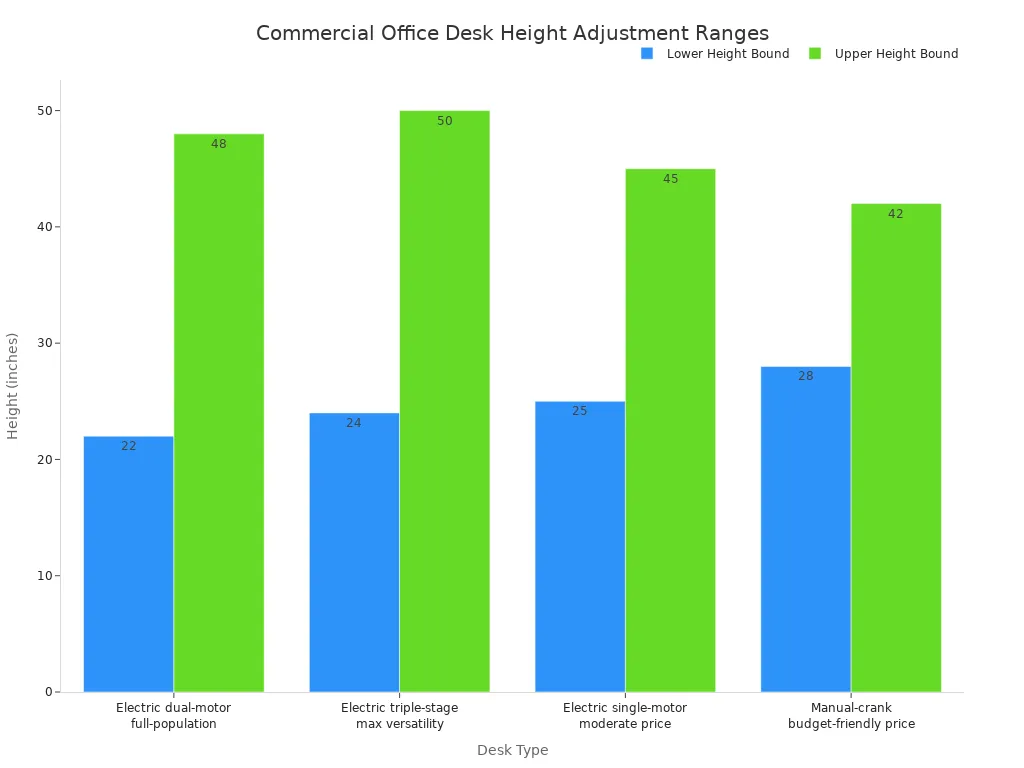
Modern sit-stand desks work for users from about 4′10″ to 6′6″. Electric dual-motor desks with a 22″–48″ range fit nearly all users. Manual-crank desks at 28″–42″ suit average-height users at a budget-friendly price. Buyers should check the actual frame travel after the worktop, glides, and accessories are fitted, not just column travel. Anti-collision behavior matters too. Under-desk trays, CPU holders, and pedestals must stay out of the movement path.
Cable management keeps work areas neat. Built-in trays and power ducts hide wires and cut clutter. Buyers should always check that the path from building supply to point of use stays clear. Desktop charging, under-desk distribution, and floor-box routes all need planning.
Style also fits a company's brand. Sleek metals and glass show a modern, tech-forward look. Warm woods and fabrics fit friendly brands. Minimalist design reduces visual noise and lets core brand values show clearly. SpaceUnited's slogan, "Minimalist Aesthetics, Redefining Modern Workspaces," captures this idea.
Benefits of Quality Commercial Office Desks
Productivity and Health
Strong, ergonomic desks help workers feel less tired and have fewer muscle and joint problems. People who sit at badly designed stations report more pain in their back, neck, and shoulders. That pain slows them down and lowers how much work they get done each day. Good commercial office desks fix this problem with better materials and smarter design.
Sit-stand desks get people to move more during the workday. A Danish study found that reminders made light users stand twice as long. Workers who stood 20% or less during their day responded best to these prompts. The German Institut für Gesundheit und Ergonomie showed similar results. Office workers with reminder-equipped sit-stand desks became more active during working hours. This movement helps keep energy up and cuts down on long periods of sitting.
Employee Satisfaction and Retention
Well-designed workspaces make employees happier and help keep good talent. Ergonomic chairs, height-adjustable desks, and good lighting ease physical strain. Workers think more clearly and stay involved. A nice office can beat remote or co-working spaces. Employees feel valued when their workspace helps them stay healthy. That feeling builds loyalty and lowers turnover.
Factor | Lower-cost furniture | Quality commercial desks |
|---|---|---|
Materials | Lower-grade materials | Commercial-grade hardwoods, premium joinery, quality finishes |
Service life | Replaced every few years | Frequently functional for 10–20 years or more |
Replacement frequency | High | Much lower |
Total cost of ownership | Higher over time | Lower over useful life |
In fast-paced environments throughout Brazos County — from administrative offices to higher education and healthcare — durability isn't optional. A desk that performs well over time reduces replacement cycles, minimizes disruption, and becomes a dependable part of the workspace rather than a recurring problem.
SpaceUnited's mission is to create practical and good-looking spaces that boost productivity and comfort. The brand's strong materials and low upkeep needs save money over time. Businesses avoid buying cheap furniture every few years. Instead, they invest once in desks that last.
Picking the right commercial office desks comes down to space, budget, and how work flows. Bench desks help people work together. Cubicles give workers the privacy they need. Modular systems can change shape fast, so teams can grow without a big hassle. This cuts moving costs and makes the most of your floor space.
Put ergonomics first. Adjustable chairs and sit-stand desks help workers feel less tired. Good layouts ease strain on muscles and bones. Plan areas for quiet focus and for team projects. Add tech like built-in cable trays and monitor arms. Set up each workstation for its role. Traders, analysts, and advisors all need different things. Quality workstations last for years, so you replace them less often. These ideas guide modern workspace upgrades. Invest in flexible setups for hybrid work.
Check what your workspace needs today. Email SpaceUnited at dandy@suofficespace.com. Find custom solutions at https://www.suofficespace.com/. This boosts productivity and comfort for your team.
FAQ
What materials make a commercial desk durable?
Strong desks use an all-steel frame and an MFC tabletop. These materials handle long daily use and heavy equipment. Commercial-grade construction resists warping and wear. Quality desks often last 10 to 20 years.
How does the SpaceUnited Parco workstation support office layouts?
Parco offers a simple single-row design. It fits one, two, or three people. Depths range from 600 to 1000mm. Widths range from 1200 to 2000mm. Height stays fixed at 750mm. These options adapt to different floor plans.
Does the Parco workstation include cable management?
Yes. It has built-in cable trays and power ducts. These hide wires and keep desks tidy. Users can choose right-angle or rounded corners. Assembly takes about 30 minutes.
Can buyers customize commercial workstations?
Yes. SpaceUnited accepts planned drawings and gives customized furniture recommendations. The brand manufactures in a 30,000 square meter factory. It holds over 130 product patents and ships globally. Clients receive tailored solutions for their workspaces.
How can a business get pricing and support?
Contact SpaceUnited at dandy@suofficespace.com or visit suofficespace.com. The team helps select and configure workstations. Investing in quality desks improves productivity and employee comfort. Action today creates a better workspace.


The Complete Guide to Commercial Office Desks for Modern Workspaces
Commercial office desks are workstations for offices, not homes. They stand up to long workdays, heavy use, and strict safety rules. These desks differ from home furniture in materials, construction, and design intent.Modern offices depend on them for productivity, ergonomics, and a professional loo
/ Read More
Office Desk Dimensions: Width, Depth, Height & Room Fit
Choose a desk by checking three things: the equipment on top, the person working at it, and the space around it. A desktop can fit against a wall yet leave too little room for the chair or an open drawer.Office desk dimensions usually describe width, depth and height. They do not tell you the clear
/ Read More
Office Desk or Executive Office Desk Which Fits Your Private Office Needs
He steps into his new private office, ready to shape a productive environment that reflects his ambitions. The right desk sets the tone—an executive office desk offers a lasting impression for leaders who value prestige and authority, while a modern office desk supports professionals focused on effi
/ Read More
7 Expert Tips for Choosing the Best Manager Office Desk
The right manager office desk transforms the daily experience in any workspace. He gains efficiency, comfort, and a professional look with a desk that fits his needs. When choosing a manager office desk, he must consider size, material, and design to match his workflow.
/ Read More
L-Shaped Office Desk Benefits Every Private Office Should Know
Choosing the right desk has a significant impact on daily productivity. Many employees notice that clutter and disorganization can slow them down. An l-shaped office desk is an excellent solution to this issue, as it efficiently utilizes corner space and provides designated areas for various tasks.
/ Read More
Complete Guide to Choosing L-Shaped Office Desks with Storage
An l-shaped office desk transforms any workspace by providing extra room and improved organization. With built-in storage, an l-shaped office desk keeps important items within reach, reducing clutter and distractions. Recent studies show that an l-shaped office desk makes storage more convenient.
/ Read More
What Makes a Modern Executive Office Desk Ideal for Productivity
A modern office desk executive drives productivity through features that blend ergonomic design, premium materials, storage, technology integration, and minimalist aesthetics. SpaceUnited’s innovative Modern Straight Line Workstation Employee Modular Desk sets a new standard for comfort and efficien
/ Read More What is considered an executive office desk in private offices
An executive office desk shows where the boss works in a private office. This desk is big, so leaders can do their work easily. It has storage built in to keep important papers close. The executive office desk uses high-quality materials. This makes it look nice and last a long time.
/ Read More