


Some are, but not all. If you are asking “are glass whiteboards magnetic” because a magnet will not stay put, first identify whether that exact writing face is designed for magnetic use. A magnetic glass board also needs a magnet suited to its construction; a magnet that works on a fridge may not work through the glass.
There are two different problems: no attachment at all, and attachment that fails when you add paper. The board's backing, the distance to it and the particular magnet help explain both.
The magnetic part is the board assembly, not ordinary glass
Ordinary glass does not provide the everyday magnetic attraction needed to hold a notice. University of Illinois physicists describe its magnetic response as very weak, while noting that specialized scientific glasses can behave differently.
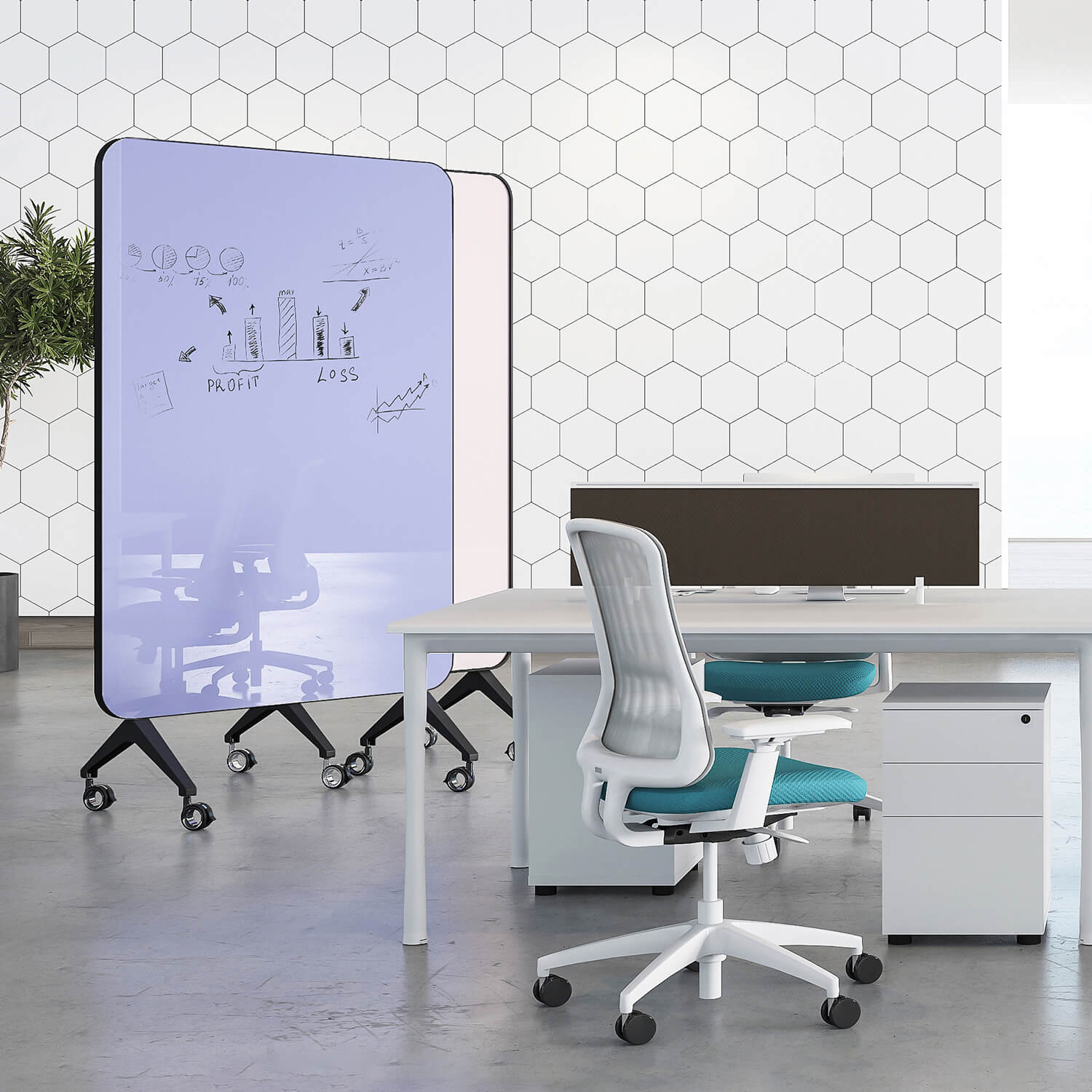
Two mobile glass writing boards with rounded frames and caster bases.
Where the attraction comes from
One established magnetic-board construction places steel behind the glass writing surface. The accessory magnet attracts that backing across the glass. For example, the University of Kentucky's 2024 Scovell Hall specifications call for steel-backed glass markerboards for magnetic use. This is a particular assembly, not a description of every glass whiteboard.
In that design, the order from the room inward is magnet, any paper, glass, then the steel backing. Other layers may also be present. The word “tempered,” a white finish or attraction to a metal frame does not establish that the writing face is magnetic.
What to verify on the actual board
Use the model label, packaging or purchase record to identify the face. A nonmagnetic glass face can still serve as a writing surface; stronger magnets are not a way to supply missing magnetic backing.
Why attachment is different from holding paper
The glass puts distance between the magnet and the backing. Kentucky's physics teaching material explains that magnetic force weakens with distance. This is why performance on exposed steel does not establish performance across a glass-board assembly.
Glass is not simply a shield that switches magnetism off. Illinois physicists describe the effect of ordinary glass at a fixed separation as very small. The separation and the complete construction matter when matching the accessory.
Holding paper: A hanging notice also has to resist sliding down. OpenStax describes friction as resistance to relative motion between contacting surfaces. Applied to a notice on a vertical board, attraction toward the backing and resistance to downward sliding are related but different parts of the task.
Changing the gap: Paper, card or a sleeve changes the gap, weight and contacting surfaces. A magnet that stays on bare glass may not hold that notice. “Neodymium” is a material name, not a guarantee for every size or housing; use the accessory specified for the board and the intended display, not a strength label alone.
Match the symptom to the next action
Different symptoms need different checks | |
What happens | Next useful action |
|---|---|
No attachment to the face | Identify the board face and its specified magnet. Failure of an ordinary magnet alone does not distinguish nonmagnetic glass from an incompatible accessory. |
It attaches, then slides with paper | Remove the notice. Compare the intended paper and magnet with the maker's permitted use; attachment alone is not a paper-capacity rating. |
The pairing used to work | Check for a changed magnet, thicker paper or sleeve, different face, residue or damage. A changed pairing does not mean the glass lost its magnetism. |
One area or side behaves differently | Record the face and location. Ask the supplier whether that behavior is expected rather than opening the board to inspect it. |
Face combinations can differ within a product range. SpaceUnited's S-series mobile glass whiteboard describes two magnetic tempered-glass writing faces. Its magnetic storage tray is a separate accessory: a tray staying in place does not establish which paper magnet you need.

Tray holding board markers and an eraser beside the glass writing face.
The G-series glass-and-fabric board pairs magnetic writing on the glass side with pinned notices on the fabric side; dual-glass configurations are also offered. Identify your delivered face combination rather than relying on “double-sided” alone.
Try only the intended normal use
Start with an intact board supported as its instructions require. For a mobile board, set its brakes as instructed. Use only an accessory intended for that model, and keep your hands clear of places where magnets can snap together.
Inspect the magnet's intended contact face for damage or debris. Use the specified care method; do not add tape, pads or abrasive treatment to change its grip.
At an accessible part of the board, place the intended magnet without paper using its handling instructions. If it will not stay, remove it and return to identifying the face and accessory.
If it stays, try one light sheet within the maker's stated use. Keep it within reach and remove the paper and magnet if either slides. Change only one thing when comparing; do not increase weight until something falls.
A light-sheet observation does not establish a limit for a heavier stack, holder or shelf. Stop using damaged glass, frames or magnet casings. Do not dismantle the board, add steel backing or stack stronger magnets to force an attachment.
Keep loose magnets inaccessible to anyone who might swallow them, and collect dropped pieces promptly. The U.S. Consumer Product Safety Commission warns that swallowed high-powered magnets can cause serious internal injury. If swallowing is suspected, seek immediate medical attention.
Identify the board-and-magnet pairing
Confirm the exact face, use its compatible magnet and distinguish no attachment from sliding with paper. If the intended pairing still fails, give SpaceUnited whiteboard support the board model, magnet reference, face and symptom, with a photo of the notice. Mention whether that same pairing worked before.
Ask for a compatible accessory or service advice for the actual symptom. Use another suitable notice display while an uncertain or damaged setup is being resolved.


Office Desk or Executive Office Desk Which Fits Your Private Office Needs
He steps into his new private office, ready to shape a productive environment that reflects his ambitions. The right desk sets the tone—an executive office desk offers a lasting impression for leaders who value prestige and authority, while a modern office desk supports professionals focused on effi
/ Read More
7 Expert Tips for Choosing the Best Manager Office Desk
The right manager office desk transforms the daily experience in any workspace. He gains efficiency, comfort, and a professional look with a desk that fits his needs. When choosing a manager office desk, he must consider size, material, and design to match his workflow.
/ Read More
L-Shaped Office Desk Benefits Every Private Office Should Know
Choosing the right desk has a significant impact on daily productivity. Many employees notice that clutter and disorganization can slow them down. An l-shaped office desk is an excellent solution to this issue, as it efficiently utilizes corner space and provides designated areas for various tasks.
/ Read More
What Makes an Executive Desk Truly Luxurious in 2026
A luxury executive desk in 2026 is the main part of a fancy office. It is made with great materials and skill. It has smart designs that help people work better. It also has built-in technology and can be made to fit your style. These things make work easier and make you feel special.
/ Read More What is considered an executive office desk in private offices
An executive office desk shows where the boss works in a private office. This desk is big, so leaders can do their work easily. It has storage built in to keep important papers close. The executive office desk uses high-quality materials. This makes it look nice and last a long time.
/ Read More
What are the different types of modern office desks?
You can pick from executive desks, modular staff benching, collaborative tables, and special training desks. The right modern office desk helps you feel comfortable and work better. If your desk fits your work and space, you can focus more and have more ideas.
/ Read More