


When evaluating an office soundproof pod or privacy booth, most corporate purchasers instinctively fixate on exterior aesthetics and unit price. However, what truly determines whether an acoustic pod permanently resolves open-plan office distractions—or ends up as an abandoned glass closet—is a set of quantifiable, lab-verified engineering parameters.
These non-negotiable metrics include certified speech reduction ratings, CO₂ safety-compliant air exchange rates, flicker-free ergonomic lighting, and precision structural perimeter sealing. This comprehensive guide breaks down each critical technical benchmark, explaining why it matters and providing clear procurement thresholds to ensure your investment delivers measurable workplace ROI.
I. The Science of Soundproofing: What the Numbers Truly Mean
The term "soundproof" is routinely abused across the commercial furniture market. In real-world physics, no office pod achieves absolute silence—nor should it. What a professional acoustic pod genuinely provides is speech privacy (the condition where ambient office hum masks residual acoustic leakage, rendering internal conversations unintelligible to anyone standing outside).
ISO 23351-1:2020 Standard & DS,A Rating Explained
The ISO 23351-1:2020 standard is the globally recognized, authoritative testing benchmark specifically created for office phone booths, acoustic pods, and semi-enclosed furniture ensembles. Unlike architectural wall tests like STC (Sound Transmission Class), ISO 23351-1 measures the actual level of speech reduction (denoted as DS,A in decibels)—the direct metric that dictates conversational confidentiality in bustling open-plan work environments.
Under ISO 23351-1, acoustic enclosures are categorized into four distinct performance tiers:
• Class A+ (DS,A > 39 dB): Extreme acoustic isolation, exceeding typical enterprise requirements.
• Class A (DS,A ≥ 30 dB): Robust speech privacy. This is the gold standard for corporate procurement, ensuring complete conversational confidentiality outside the booth.
• Class B (DS,A ≥ 25 dB): Moderate privacy; vocal cadences and occasional words may remain perceptible during ambient quiet hours.
• Class C / D (DS,A < 25 dB): Rudimentary privacy, typical of partial cubicle partitions and soft decorative acoustic dividers.
★ SpaceUnited Engineering Milestone: All SpaceUnited models—S, M, SL, L, and XL—are fully certified to ISO 23351-1 Class A (30 dB reduction). Standing at a natural working distance outside the pod, adjacent colleagues cannot decipher your sensitive client calls, executive meetings, or video conferences.
STC vs. NIC vs. ISO 23351-1: Which Metric Truly Matters?
Many manufacturers obfuscate acoustic capabilities by quoting laboratory STC ratings. Here is the distinction:
• STC (Sound Transmission Class): Measures laboratory transmission loss across static single-panel walls. It does not account for door seals, airflow ducts, or the specific frequency spectrum of human speech.
• NIC (Noise Isolation Class): An improvement over STC that evaluates field isolation between two enclosed rooms, but remains uncalibrated for semi-enclosed furniture units in open spaces.
• ISO 23351-1:2020: The only internationally standardized protocol that isolates voice frequency attenuation in modern open offices. Always demand third-party ISO 23351-1 test certificates rather than manufacturer-claimed STC ratings.
The Weakest Links: Perimeter Door Gaskets & Acoustic Glass
An acoustic pod's solid composite walls can be engineered to near-perfection. Yet, over 90% of acoustic failures occur at two vulnerable vulnerability points: perimeter seals and glazed panels.
Dual-Perimeter Gasket Seals: A dual-perimeter sealing system—one continuous gasket along the jamb frame and a second along the glass door edge—is the engineering baseline for Class A isolation. Standard single-rubber strips degrade and lose compression over time. Remarkably, Even a tiny gap under or around the door may degrade the overall acoustic performance.
• Acoustic PVB Laminated Glass: Standard single-pane tempered glass resonates severely under acoustic pressure waves, becoming virtually acoustically transparent at its "coincidence frequency." Double-layer laminated safety glass bonded with an internal PVB (Polyvinyl Butyral) acoustic interlayer dampens structural vibration, flattens resonance spikes, and prevents shattering.
★ SpaceUnited Dual-Barrier Standard: Every SpaceUnited booth incorporates dual-gasket magnetic perimeter sealing and acoustic PVB laminated glass. Furthermore, specialized vibration-damping isolators are integrated between base levelers and the office floor to decouple structural low-frequency vibrations.
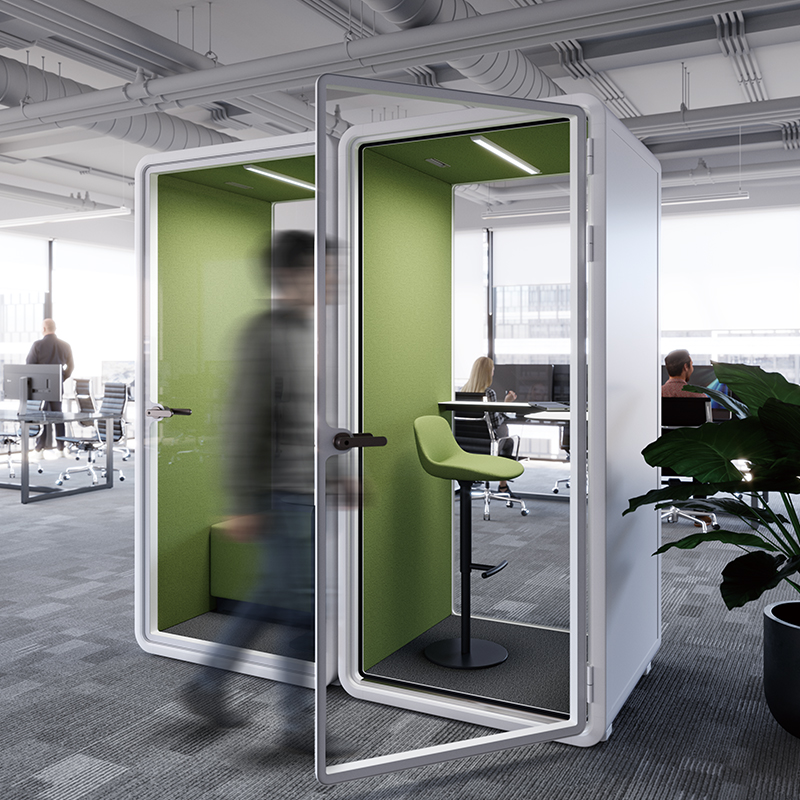
Acoustic Pod-S
II. Ventilation, Air Quality & Solving "Pod Fatigue"
An acoustic pod is only as valuable as employees' willingness to inhabit it. Across corporate facilities, the primary grievance regarding acoustic pods is not sound leakage, but thermal discomfort, CO₂ accumulation, and noisy ventilation fans. This combination triggers "pod fatigue," causing employees to abandon booths after just a few weeks of use.
Airflow Volume: The Non-Negotiable Health Baseline
In an enclosed space, CO₂ concentration rises rapidly once people stay inside, causing fatigue and poor concentration. Prolonged work inside the booth will also reduce work efficiency. For a single-person phone booth, the minimum acceptable ventilation rate is 30 to 50 m³/h (18–30 CFM)—sufficient to renew internal air volume every 1 to 2 minutes.
★ SpaceUnited Stepless Climate Control: SpaceUnited pods feature an intelligent environmental control module with continuously variable, dial-controlled airflow—from 0–49 m³/h on the S Booth up to 0–221 m³/h on the 6-person XL Conference Pod. Integrated PIR infrared occupancy sensors automatically activate ventilation upon entry and power down after exit.
The Four-Tier Engineered Ventilation Architecture
1. Dual-Directional Pressure Balancing: Dedicated fans on both intake and exhaust channels maintain neutral internal air pressure, preventing air-pressure ear discomfort and gasket stress.
2. Ultra-Quiet Centrifugal Blowers: Unlike buzzy axial computer fans, curved centrifugal impellers generate high static pressure at low RPM, delivering high volumetric airflow below 35 dB(A) background noise.
3. Automated 30-Minute Purge Cycle: Every 30 minutes, the system executes an automated 5-minute full-purge flush regardless of occupancy, keeping internal ducts pristine, dry, and odor-free.
4. Architectural Acoustic Silencer Plenums: Labyrinth-baffled ventilation plenums lined with acoustic foam trap sound waves while permitting unimpeded airflow, preventing ventilation ducting from becoming an acoustic bridge.
Internal Acoustics: Echo Suppression for Video Conferencing
Blocking exterior noise is only half the battle. A bare interior creates a hollow "aquarium echo" during Zoom and Teams calls. Interior reverberation time (RT) must be maintained under 0.3 seconds.
★ SpaceUnited Multi-Layer Composite Construction: SpaceUnited pairs exterior acoustic-grade sheet steel with high-density interior acoustic wool and recycled PET felt panels to achieve balanced speech clarity without creating an unnaturally muted "dead room."
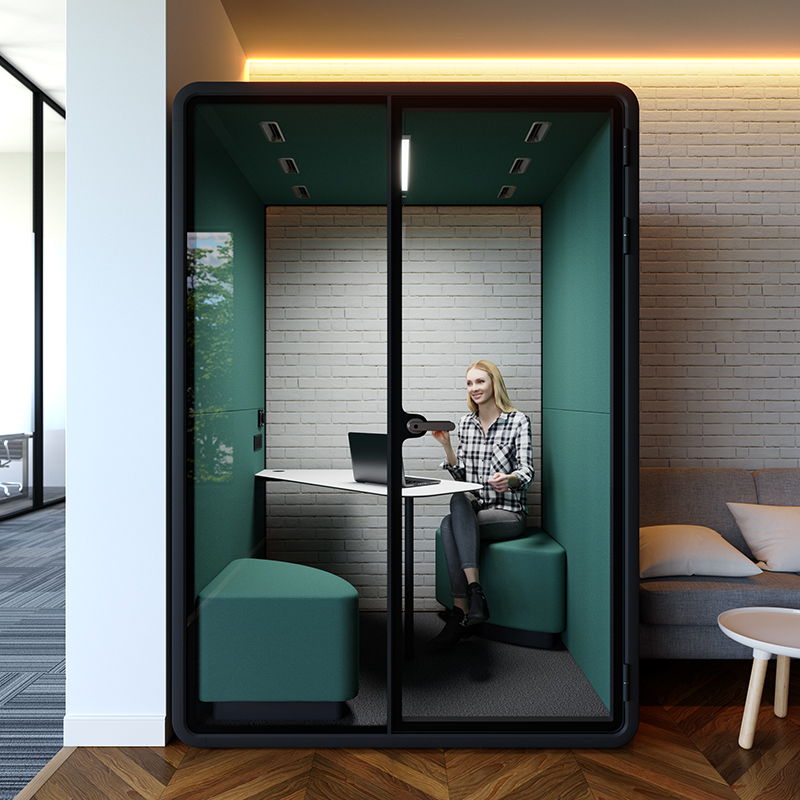
Acoustic Pod-M
III. Ergonomic Lighting: The Productivity Catalyst
Deprived of exterior windows, pod occupants depend entirely on artificial illumination. Inadequate lighting triggers eye strain, tension headaches, and unflattering video feeds during executive calls.
• Color Rendering Index (CRI ≥ 90): While standard office lights settle for CRI 80, professional video calls require CRI 90+ to accurately render natural skin tones without sickly green or grey casts.
• Tunable White Spectrum (3000K–6000K): Permits seamless transition from 3000K warm white (relaxed ideation and evening work) to 6000K daylight white (high-focus detail work).
• Flicker-Free DC Driver & Low Glare (UGR ≤ 20): High-frequency DC constant-current power supply combined with micro-prismatic diffusion panels completely eradicates subtle LED flicker and eye-straining glare.
★ SpaceUnited OSRAM Light Modules: SpaceUnited standardizes on genuine OSRAM commercial LED modules boasting CRI 92, UGR ≤ 20, and continuous 3000K–6000K color temperature tuning, managed via a clean, consolidated rotary dial.
IV. Modular Architecture & Real-World Mobility
Modern corporate environments evolve continuously. An acoustic booth that demands invasive demolition crews to relocate is a static liability. Turnkey modularity safeguards long-term total cost of ownership (TCO).
• Rapid 1-Hour Zero-Permit Assembly: A precision-engineered single booth must assemble within 60 minutes using two general personnel—without drilling, gluing, or municipal building permits. No structural building modifications are required, preserving 100% of the asset's residual value upon office lease relocation.
• Heavy-Duty Retractable Casters: Optional integrated casters rated for total operating weight (S Booth weighs 265 kg / 584 lbs) allow effortless repositioning across open floor plates as departments reorganize.
• Enterprise Power Hub: Every booth includes universal AC power outlets, dual USB Type-A, USB Type-C high-speed charging, and optional 15W wireless desktop inductive chargers.
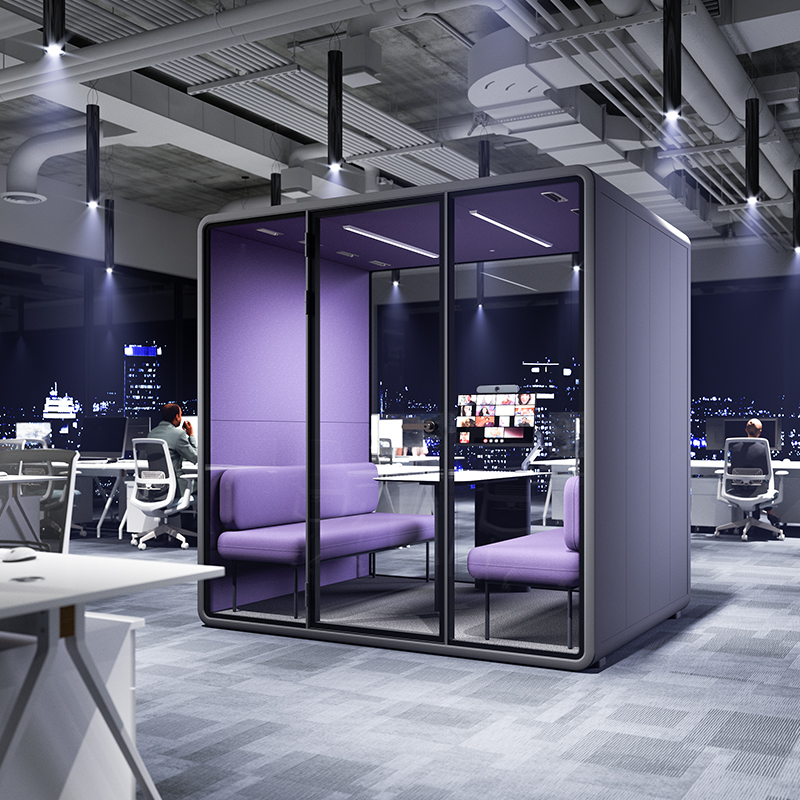
Acoustic Pod-L
V. Standard Pods vs. High-Performance Engineering: Feature Comparison
The table below contrasts mass-market budget booths with enterprise-grade acoustic engineering standards:
Feature / Component | Mass-Market Standard | SpaceUnited High-Performance Standard |
Sound Reduction | 20–25 dB (Uncertified STC) | 30 dB, ISO 23351-1 Class A Certified |
Ventilation Volume | Fixed 15–20 m³/h (Buzzy axial fan) | Stepless 0–49 m³/h (Centrifugal silent fan) |
Lighting Quality | Generic fixed 4000K, CRI 80 | OSRAM CRI 92, Tunable 3000K–6000K, UGR ≤ 20 |
Glass Technology | Single-pane tempered glass | Double-layer acoustic PVB laminated glass |
Perimeter Sealing | Single hollow rubber seal | Dual magnetic perimeter gasket system |
Frame & Structure | Particle board / standard MDF | Aviation-grade aluminum alloy + PET acoustic felt |
Deployment Speed | 4–6 hours with specialized tools | 2 persons, ~60 minutes fast modular assembly |
VI. How to Choose the Right Size: SpaceUnited Complete Series
The SpaceUnited series offers five precision configurations sharing identical acoustic isolation (ISO 23351-1 Class A 30 dB), OSRAM CRI 92 lighting, and modular connection architectures:
Model | Capacity | Footprint | Ventilation Airflow | Acoustic Rating | Power |
S Booth | 1 Person | ~1.0 m² | 0–49 m³/h (~2.5 min/cycle) | Class A (30 dB) | 40 W |
M Booth | 2 Persons | ~2.2 m² | 0–74 m³/h (~4.0 min/cycle) | Class A (30 dB) | 52 W |
SL Booth | 2 Persons | ~2.2 m² | 0–74 m³/h (~4.0 min/cycle) | Class A (30 dB) | 60 W |
L Booth | 4 Persons | ~2.2 m² | 0–140 m³/h (~3.5 min/cycle) | Class A (30 dB) | 100 W |
XL Booth | 6 Persons | ~6.8 m² | 0–221 m³/h (~4.0 min/cycle) | Class A (30 dB) | 120 W |
While the S Booth serves as the primary acoustic refuge for confidential video calls and focused work, the XL Booth (2.6m × 2.5m, 6-person capacity) functions as a complete, self-contained executive conference room—deployable overnight without architectural permits, drywall dust, or landlord lease restrictions.
VII. Conclusion: Invest in Verifiable Engineering, Not Marketing Hype
An enterprise acoustic pod represents a significant capital expenditure. It either permanently solves open-plan cognitive distraction or triggers a recurring wave of complaints regarding stale air, fan buzz, and compromised privacy. The hallmarks separating elite acoustic pods from substandard copies are entirely objective: ISO 23351-1 Class A certification, airflow ≥ 30 m³/h per person, CRI 90+ flicker-free illumination, dual-gasket laminated glass, and zero-tool modular mobility.
Always demand third-party test certificates instead of marketing brochures. Inquire about airflow in m³/h rather than "built-in fans." Verify glass lamination and perimeter gaskets before signing purchase orders.


Why Does an Office Chair Keep Sinking? Safe Checks & Repair Decisions
A chair that drops after you set the height needs attention, but the movement alone does not prove which internal part is at fault. The safest response is to stop guessing and separate what you can observe from what a manufacturer or qualified repair provider must assess.If your office chair keeps s
/ Read More
Sofa Foam Density vs Firmness: What Buyers Can and Cannot Infer
A procurement reviewer should not approve a sofa cushion from one number. Density tells you mass per unit volume. Firmness tells you how strongly a defined sample resists a defined indentation. Those are separate properties.The common shortcut—high density means hard—can fail in both directions.
/ Read More
Folding Training Tables: What to Check Before Buying
A table can look compact in a product photo and still fail your storage plan. The buyer needs proof of what moves, what locks, how the exact quantity stores, and whether staff can handle the sample on the real route.That proof starts with clear language. A mobile table is not automatically foldable.
/ Read More
Whiteboard Accessories: Markers, Erasers, Magnets & Mounting Kits
Before ordering whiteboard accessories, identify the exact board model and label every working face: glass, another verified dry-erase surface, or tackable felt. Then match each marker, eraser, magnet, holder, pin, or hardware item to that face and model. If either identity is uncertain, place the i
/ Read More
How to Hang a Whiteboard: Wall Type, Hardware & Mounting Height
Do not start by choosing an anchor. Start by matching the delivered board to its current installation instructions, confirming the wall assembly, and assigning a qualified person to approve the method. If the model, board or package weight, bracket drawing, packing list, wall construction, or concea
/ Read More
What Is a Credenza? Office Uses, Storage Types & Buying Checks
A cabinet can fit the wall and still fail the job: folders may not pass through the opening, drawers may hit a chair, or cables may have nowhere usable to go.If you are asking what is a credenza, the office answer is a long, low storage cabinet that usually sits behind or beside a primary desk.
/ Read More
How to Clean a Fabric Sofa: Care Codes, Spot Tests & Office Maintenance
A spill on a reception sofa creates two jobs: contain the mess and avoid turning a small mark into permanent damage. Do not reach for a cleaner until you know the installed sofa model, the exact upholstery selection, and the care instructions that apply to that order.The safe answer to how to clean
/ Read More
Leather vs Fabric Sofas for Offices: Cleaning, Wear & Buying Trade-Offs
An office reception buyer is not choosing between two simple surfaces. Genuine leather, PU or synthetic leather, and fabric have different finishes, backings, care limits, and ways of showing wear. A label or product photo does not settle those details.The practical answer to the leather vs fabric s
/ Read MoreFAQ
Q1: How much noise does an office phone booth actually block in practice?
A certified ISO 23351-1 Class A pod reduces voice levels by 30 dB. In practical terms, this transforms a bustling 70 dB open-plan office into a peaceful 40 dB library-like environment inside. Simultaneously, external colleagues standing directly outside cannot decipher what is being said within the booth, ensuring total conversational privacy.
Q2: Will an acoustic pod feel stuffy, hot, or claustrophobic during long meetings?
Q3: How difficult is it to install and relocate a soundproof booth in an existing office?
Q4: What is the technical difference between STC and ISO 23351-1?