


A cabinet can fit the wall and still fail the job: folders may not pass through the opening, drawers may hit a chair, or cables may have nowhere usable to go.
If you are asking what is a credenza, the office answer is a long, low storage cabinet that usually sits behind or beside a primary desk. It may combine doors, drawers, open shelves, and a flat top, but the name alone does not guarantee file storage, equipment support, seated work space, or rated security.
Use the guide below to match the cabinet to the office task, then check four kinds of fit: the usable interior, the clear opening, the space needed while doors or drawers are open, and the route for cables or equipment. You will also see how to separate verified product facts from details that still need supplier confirmation.
What Is a Credenza in an Office?
Item | Description |
|---|---|
Basic form | A long, low cabinet with storage below and a flat top. |
Office role | Secondary storage placed behind, beside, or along a wall near a primary desk. |
Common interiors | Doors, drawers, open shelves, or a mix; the exact layout changes by model. |
What the name does not prove | Hanging-file fit, equipment support, seated knee space, load capacity, or a security rating. |
The useful office definition is based on role, not a strict style rule. A credenza keeps supplies, current documents, or display items close to the work area while leaving the primary desk for active tasks. Some models add purpose-built file drawers or cable features, but those are configurations to verify, not features included by default.
Use the label, then verify the modelUse “credenza” to find the right furniture category. Use the model drawing and specifications to decide what the cabinet can actually do. |
Match the Credenza to the Office Job
List what will go inside before choosing a finish or cabinet width. The right frontage depends on item size, access frequency, visibility, and the evidence required for the job.
Office credenza use matrix | |||
Office job | Useful configuration | Confirm before selection | Stop condition |
|---|---|---|---|
Everyday supplies | General drawers or closed shelves near the user | Net drawer or shelf size, reach, drawer extension, and item grouping | The opening is too small, or an open drawer blocks the chair or path |
Active paper files | A purpose-built file drawer or documented folder rails | Letter or legal format, rail direction, clear height and width, and usable extension | The page only says “drawer” or “document storage” without folder-fit data |
Reference or display items | Open shelves for quick access; doors where dust or visual order matters | Item envelope, shelf spacing, supported load, and whether shelves adjust | The item overhangs, the shelf load is unknown, or the layout hides daily materials |
Printer or other equipment | Open or enclosed bay only when the exact device is supported | Device and connector dimensions, service access, cable route, ventilation instructions, and top or shelf load | A cable hole or vent is the only evidence of equipment suitability |
Meeting or visitor materials | Closed shelves for supplies, open bays for frequently used handouts | Who needs access, replenishment volume, and door space during meetings | Open doors or drawers enter the visitor or circulation zone |
Choose the interior from the jobIf one cabinet must handle several jobs, verify each compartment separately. A useful supply drawer does not prove file fit, and an open bay does not prove equipment support. |
Use the Four-Fit Check Before You Buy
Exterior dimensions describe the closed cabinet, not usable space, a clear opening, or an open door or drawer. Record all four fits in one unit.
Inside Fit — Measure the item's widest, deepest, and tallest points. Add handling or connector allowance, then compare with net internal dimensions after panels, hinges, slides, shelves, and cable hardware.
Opening Fit — Measure the smallest clear width and height. Use the door position possible in the real room. A large compartment still fails if hardware narrows the route.
Operating Fit — Add closed depth to the farthest door swing or drawer projection. It must fit without trapping the chair or entering a required path. Ask the project designer to apply site rules; US Access Board guidance on protruding objects and circulation paths explains that cabinets and other objects can affect circulation paths.
Connection Fit — Trace the largest plug or connector from the device to power and data. Check pass-through size, bend space, strain relief, service access, outlet position, the device maker's ventilation instructions, and documented support for the device's weight.
Try the Worksheet With Hypothetical Numbers
Item envelope: ____ W × ____ D × ____ H
Allowance on each side: ____; required compartment: ____ W × ____ D × ____ H
Clear opening: ____ W × ____ H; does every required dimension pass? Yes / No
Closed cabinet depth: ____ + maximum front projection: ____ = temporary operating depth: ____
Remaining free area with door or drawer open: ____; site review completed: Yes / No
Largest connector and bend/service allowance: ____; continuous route confirmed: Yes / No
Top or shelf load and equipment instructions matched to the exact model: Yes / No
Example only — not a P28 or field measurementAssume an item is 430 W × 360 D × 410 H mm. With 20 mm allowance on every side, the target compartment is at least 470 W × 400 D × 450 H mm. A hypothetical cabinet may have a 520 mm-wide interior but only a 460 mm-wide clear opening. It fails Opening Fit because the 470 mm requirement cannot pass through 460 mm. If its closed depth is 500 mm and a drawer projects 430 mm, its temporary operating depth is 930 mm. Compare 930 mm with the actual free zone; it is not a universal clearance recommendation. |
P28 Example: Public Facts and Evidence Limits
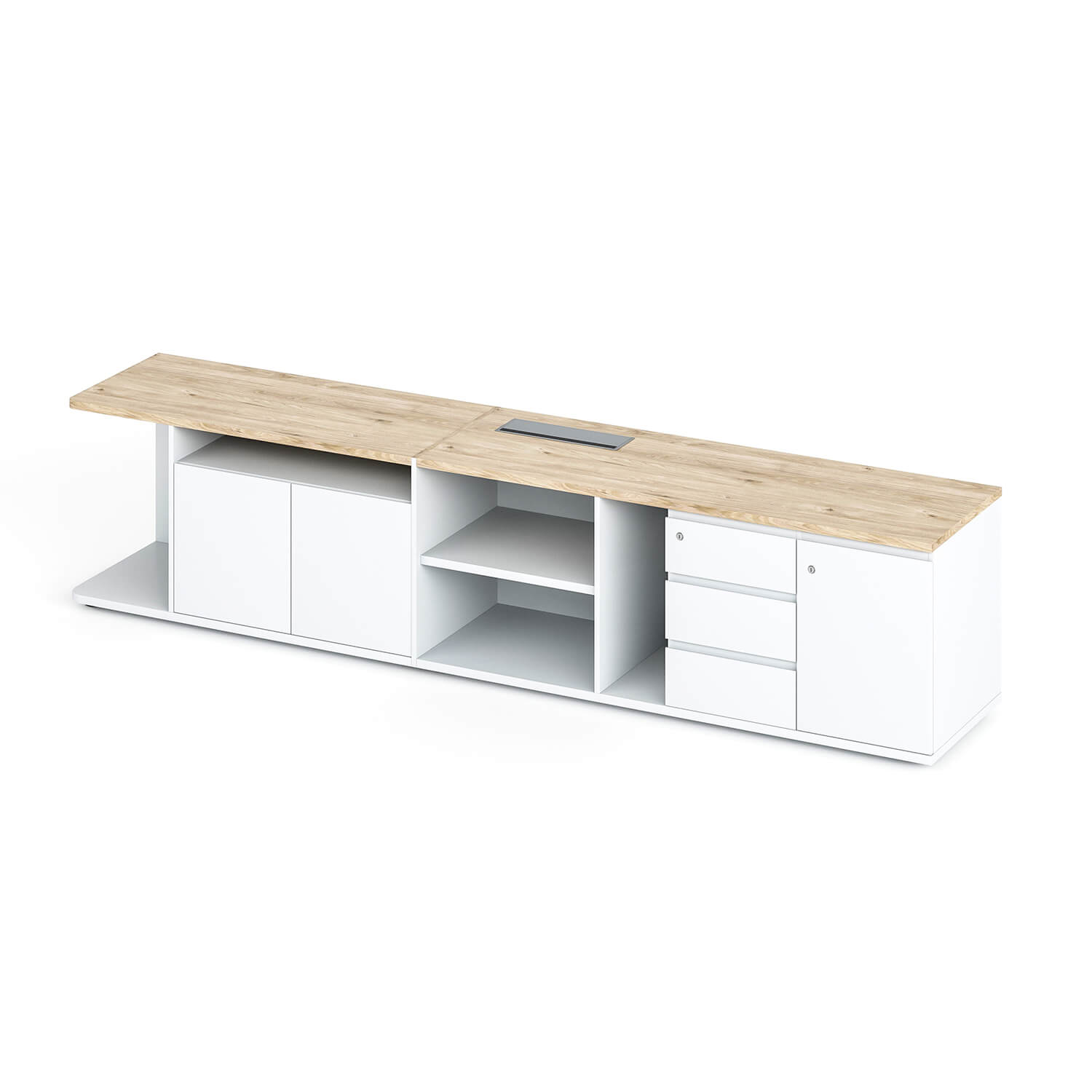
The live SpaceUnited Executive Office Side Cabinet page lists two models: SU-OS-CAB-89 at 2400 W × 500 D × 630 H mm and SU-OS-CAB-90 at 2800 W × 500 D × 630 H mm. These are published exterior dimensions. The page lists MFC and says both widths share a layout with a three-drawer lockable unit, hinged-door storage, open shelves, and cable and ventilation openings.
What the P28 page can and cannot establish | |||
Check | Public fact | Still needed | Allowed conclusion |
|---|---|---|---|
Inside and opening fit | Two exterior size rows | Net compartment and smallest clear-opening dimensions | The overall room envelope is known; storage fit is not |
Files and security | Three-drawer lockable unit | Folder format, rail details, usable drawer size, and any required security evidence | Drawers and a lock are stated; file fit and security grade are not |
Connections and ventilation | Cable box/channels and a host-unit ventilation opening are described | Connector clearance, route drawing, device instructions, supported load, and thermal evidence | Openings are stated; equipment or cooling performance is not verified |
Material claim | The page lists MFC and uses E0 wording | Named standard, test method, laboratory/report, revision, and exact SKU match | MFC may be reported; certification or emissions performance may not |
Work surface | A flat top and open bays appear in the product content | Top/shelf load and documented knee clearance or intended seated use | Do not treat it as a seated desk or approved equipment platform |

This P28 rendering shows a cable route and perforated panel, not verified connector, load, or cooling performance.
Safe shortlist conclusionThe public page is enough to identify the two models, their exterior sizes, and the stated storage layout. It is not enough to approve a folder, device, high-security record, seated-work task, or required environmental claim. Request the missing drawing and matched documents first. |
When a Credenza Is the Wrong Choice
Stop when the intended job depends on a feature the model does not document. Purpose-built furniture is clearer than forcing a general cabinet into specialized work.
If hinged doors create the conflict, compare a sliding office cabinet with the same opening and access checks.
You need to sit at it — choose a desk or return with documented knee space, height, intended use, and load.
You need guaranteed hanging-file fit — choose a purpose-built file cabinet or a credenza with stated folder format, rails, clear dimensions, and usable drawer extension.
You need a device station — use furniture with matched loads, connector access, service space, and device-compatible ventilation instructions.
You need stronger record protection — specify required access control, security, fire, or environmental performance instead of relying on a basic furniture lock.
An open door or drawer reduces the usable chair or circulation zone — change the position or cabinet before approval. The project team must apply site rules.
A contract requires certification or tested performance — obtain the model, standard, report, laboratory, revision, and scope. A marketing label is not the document.
Missing evidence is a stop signalRequest proof, remove the unsupported use, or choose purpose-built furniture. Never replace an unknown dimension or performance requirement with an assumption. |
Send This Specification Request Before Ordering
Copy this list into the product inquiry. Ask for documents tied to the exact quoted model and configuration.
Confirm model, width, interior configuration, finish code, document revision, and date.
Provide a dimensioned drawing with overall width, depth, and height.
Provide net internal dimensions and smallest clear openings for every planned compartment or drawer.
State door swing and drawer projection, including the position needed for full access.
For files, state supported folder format, rail direction, clear height, and usable extension.
For equipment, show the complete cable route, connector, bend, and service clearance.
Provide the applicable top, shelf, and drawer loads plus equipment or ventilation instructions.
Identify the lock type and any claimed security performance; do not substitute “lockable” for a rating.
For any material, emissions, safety, durability, or environmental claim, provide the standard, test method, report, laboratory, scope, and SKU match.
Provide installation, leveling, anchoring, maintenance, and site requirements for this configuration.
Make one of three decisionsShortlist when every critical intended-use row is answered. Request evidence when a document may close the gap. Switch furniture categories when the job and the product cannot be matched. |
Practical Questions About Office Credenzas
Can an ordinary credenza drawer hold hanging files?Not unless the exact drawer is designed for your folder format. Ask for letter or legal compatibility, rail direction, clear internal width and height, and usable extension. A drawer that fits loose paper may still be too narrow or shallow for hanging folders. Can a credenza hold a printer or computer?Only when the exact model and device are compatible. Confirm the device footprint and weight, documented top or shelf load, connector and service clearance, complete cable route, and the device maker's ventilation instructions. A flat top, cable opening, or vent alone is not approval. How much room should be left in front of a credenza?Use the actual door swing or drawer projection, then add the chair, access, and circulation space required by the room plan. There is no single number for every layout. The project team should verify applicable accessibility, egress, and workplace requirements at the site. Does a lock make a credenza secure for confidential records?A lock can limit casual access, but the word “lockable” does not state a security grade, key-control method, forced-entry resistance, or fire and environmental protection. Define the record risk first, then request matched evidence or use storage specified for that protection level. |
Turn the Label Into a Verified Specification
A useful shortlist starts with the office job, not the furniture name. Record the required inside, opening, operating, and connection fit for the exact items and room. Then compare those requirements with a model drawing and matched documents.
If a clear opening, load, file format, cable route, ventilation instruction, security level, or claim document is missing, pause that use. Ask for the evidence or choose purpose-built furniture instead.
Apply the checklist Review the live SpaceUnited Executive Office Side Cabinet, select SU-OS-CAB-89 or SU-OS-CAB-90 as the exact model under review, and send the specification request before ordering. Existing P28 product page and the checklist in this article


What is the difference between a desk and a workstation?
The main difference between a desk and a workstation is how you use your space. You use a desk when you want to work alone and focus. A workstation staff desk helps teams work together and change plans quickly. Picking the right setup can make you feel happier.
/ Read More
What is a workstation desk?
A workstation desk is more than a seat. It gives you a space to focus and feel good at work. SpaceUnited began in 2015. Now, it is a top company for modern office furniture. They mix smart design with real experience. Over time, the workstation staff desk changed how people work.
/ Read More
How To Choose The Correct Office Workstations?
What are the Different Types of Office Chairs?Sitting in a busy office, struggling with daily tasks, and the glow of computer screens is already a norm for you. But sitting on the wrong chair? That shouldn’t be. Office chairs are the most important tools needed in an office as they shape your comfor
/ Read More